Paper Core Crush Strength: How to Spec It (and Why Cores Fail)
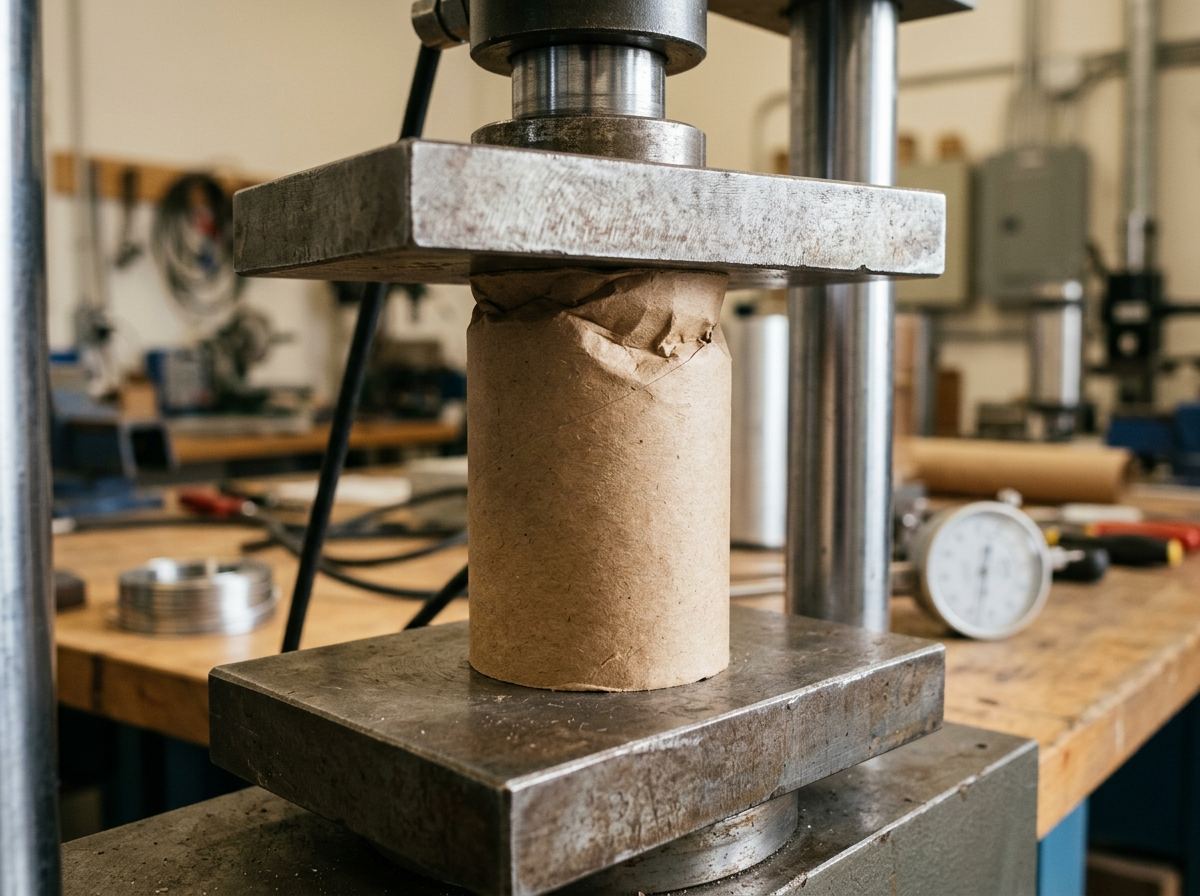
A core that collapses on the winder does not fail quietly. It stops the line, scraps the roll, and costs your team hours you do not have. Most core failures trace back to a single root cause: paper core crush strength was never properly specified for the actual load the core would carry. This article walks through how crush strength works, what drives it, and how to get the spec right before you order.
What Paper Core Crush Strength Actually Measures
Crush strength — sometimes called flat crush resistance — is the load a paper core can sustain radially before it deforms or collapses. In a flat crush test, a core sample is compressed between two parallel plates and the peak load at failure is recorded. Cores are typically evaluated with a flat-crush or radial-crush test; some mills and converters reference an industry standard, while others specify their own in-house procedure.
The number matters because winders, slitters, and rewind stands apply radial force to the core every time tension is taken up in the roll. A core that meets your wall-thickness requirement on paper but was built from lower-density plies will fail at a load your machinery hits routinely.
The Variables That Drive Crush Strength
Four factors control how much radial load a spiral-wound core can take:
- Wall thickness. More wall means more plies, which means more material to absorb radial force. NHPT manufactures to wall thicknesses from .030″ to .500″ — a range wide enough to cover lightweight tissue cores at one end and heavy industrial mandrel cores at the other. See the core ID/OD and wall-thickness reference chart to cross-reference bore size with common wall options.
- Paperboard grade and density. Not all recycled paperboard is equal. Ply adhesion, caliper consistency, and basis weight all affect how plies behave under load. A core wound from higher-density plies at the same nominal wall will outperform a lighter-stock core — which is why grade selection is part of the engineering conversation, not an afterthought.
- Inside diameter. A 3″ core and a 6″ core wound to the same wall thickness do not carry the same load. The larger the bore, the more leverage radial force has, and the harder the core has to work to resist deformation.
- Winding angle and adhesive system. In spiral-wound construction, the angle at which each ply is applied and the adhesive holding plies together both influence how load transfers through the wall. This is where manufacturing process quality shows up in finished-core performance.
If you are uncertain which combination fits your application, the team at NHPT has more than 50 years of combined paper-tube industry experience and can walk through the load case with you. Learn more about custom engineering options.
Why Cores Fail — and the Spec Mistakes That Cause It
The most common spec mistake is copying a core dimension from a previous supplier without asking what the crush strength behind that dimension actually was. Wall thickness and inside diameter are geometry; crush strength is performance. They are related but not the same thing.
A few failure patterns that appear regularly on the floor:
Undersized wall for the roll weight. A plant switches to a lower-cost core with the same ID but thinner wall and finds cores telescoping or buckling mid-roll. The fix is usually a wall increase or a move to a denser ply, not just a change of vendor.
Wrong ID for the mandrel. A core that fits too loosely on the mandrel will rock under tension, concentrating load at the edges rather than distributing it across the full bore. This creates local crush points that look like a strength failure but are actually a dimensional one.
No flat crush test requirement in the purchase spec. If your PO specifies only ID, OD, and length, you have no documented floor on what you will receive. Adding a minimum flat crush value — with a test method — gives you an acceptance criterion and gives your supplier a target. For a deeper look at paper core crush strength engineering principles, including how to calculate load requirements for your application, that page is a useful reference.
Sourcing Crush-Rated Cores from New Hampshire Paper Tube
NH Paper Tube is a custom B2B manufacturer of spiral-wound paper tubes and cores based in Raymond, New Hampshire, serving converters, mills, and plant operations throughout New England — including NH, MA, CT, ME, VT, and RI. Every core is made from 100% recycled paperboard, and NHPT recycles 100% of its production waste; finished cores are fully recyclable at end of use.
NHPT manufactures to inside diameters from 1″ to 8″, wall thicknesses from .030″ to .500″, and lengths from .25″ to 300″, with production capacity in the millions of cores per month. The $1,000 minimum order applies to all runs. Stock cores ship same day, with delivery across New England within 24 hours; custom orders are typically ready in about 5–7 business days, and emergency expedite is available for a small fee. New Hampshire’s no-sales-tax status and short one-to-two-day freight lanes into the Northeast keep landed cost competitive. Free samples are available before you commit to a run.
Request a quote or call 603-693-6136.
Related reading: “Paper Cores vs. Paper Tubes: What’s the Difference?” · “Why Paper Cores Fail on the Winder (and How to Prevent It)”