Inside-Diameter Tolerance: The Spec That Bites First
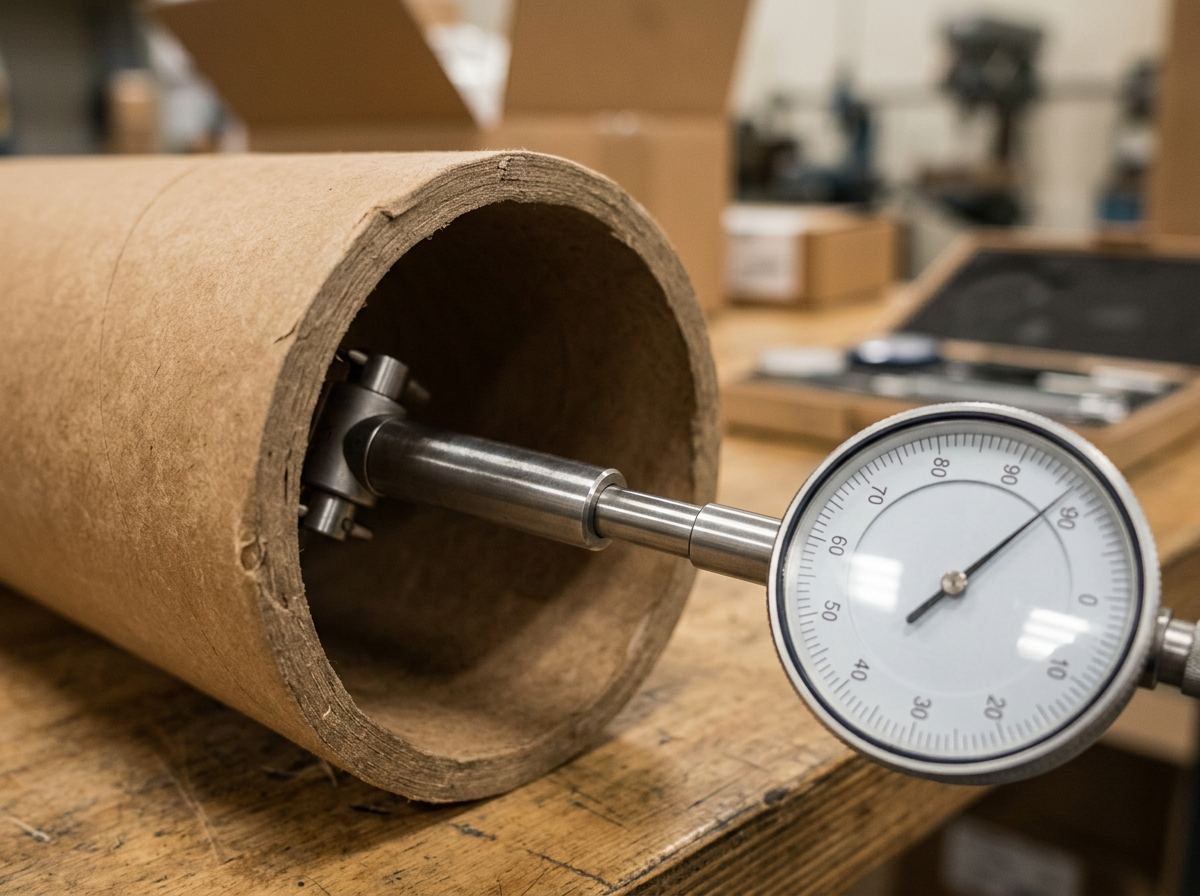
You receive a pallet of cores, load one onto the mandrel, and it won’t seat — or it wobbles. The roll slips under tension, the splice tears, and you’ve lost product and line time. The culprit is almost always paper core ID tolerance: the gap between the nominal inside diameter you ordered and what the manufacturer actually delivered. Of all the dimensional specs on a core, the ID is the one that mates with your equipment first. Get it wrong and nothing downstream goes right.
Why the ID Is the First Failure Point
A paper core doesn’t function in isolation. It has to accept a spindle, a chuck, or a winding mandrel — and that interface is governed entirely by the inside diameter. The OD matters for roll geometry; wall thickness matters for crush strength; but the ID is what determines whether the core fits your equipment at all.
When a core runs oversized, it rocks on the chuck. Under winding tension, that play translates into lateral movement, uneven layering, or outright slippage. When a core runs undersized, it won’t seat without force, and forcing it risks splitting the wall or jamming a high-speed winder. Either failure mode costs more than the cores themselves — it costs you the wound roll and the line downtime to clear it.
The problem isn’t that manufacturers can’t hold tight dimensions. It’s that buyers often don’t specify what they actually need, so the manufacturer holds whatever tolerance their standard process delivers.
What Drives Dimensional Variation in Spiral Winding
Spiral-wound cores are built by wrapping plies of paperboard on a mandrel at a continuous angle. That process introduces several sources of dimensional variation that a straight-draw extrusion or machined part simply doesn’t have:
- Moisture content of the board. Paperboard is hygroscopic. It picks up or releases moisture as ambient humidity changes, and it moves dimensionally as it does. A core wound at 6 a.m. in summer humidity and one wound at the same settings on a dry winter afternoon will not measure identically — even off the same mandrel.
- Mandrel wear. The steel forming mandrel that determines the ID has a nominal diameter, but mandrels wear with use. A worn mandrel yields a slightly larger ID than a new one. Reputable manufacturers track and replace mandrels before variation exceeds acceptable limits.
- Winding tension. The tension under which plies are wrapped compresses the assembly. Tighter winding can close the ID slightly; looser winding can open it. In practice, operators calibrate this, but it is a real variable.
- Ply adhesive and drying. The glue between plies adds a small, variable dimension. As the adhesive cures and the core dries, it can spring in or out fractionally.
None of these factors are defects — they are the physics of the process. The question is how tightly the manufacturer controls them and what tolerance band they guarantee.
Nominal ID vs. the Actual Tolerance Band
When you specify a 3″ ID core, you are specifying a nominal value. The manufacturer produces cores that cluster around that nominal, but within some band of variation above and below it. That band is the tolerance, and it is not always the same across manufacturers, processes, or even production runs.
A “loose” tolerance band is appropriate for many applications. If your mandrel has significant mechanical play, or if the core is being used as a simple storage spool that a worker slides on by hand, a wider band costs less and causes no real-world problems.
A “tight” tolerance band matters when:
- You’re running a high-speed slitter-rewinder with close-clearance chucks
- The core is driven (not just supported) and slip means splice failure
- You’re winding film, foil, or thin web where lateral movement creates defects
- The core interfaces with automated handling equipment with fixed dimensions
The tighter the tolerance you need, the more important it is to state it explicitly — and to confirm the manufacturer can actually hold it. At NHPT, tolerance bands are confirmed per order based on your application’s requirements; request a quote or free samples to validate fit on your actual equipment before committing to a production run.
See our Core ID, OD, and Wall Thickness chart for a reference on how these dimensions relate across standard core sizes.
How to Write the ID Tolerance on Your PO
Most purchasing documents say something like “3.000″ ID.” That tells the manufacturer the nominal target. It does not tell them how much variation is acceptable. To write a spec the manufacturer can actually hold — and be held to — include:
The nominal ID plus the bilateral tolerance band. For example: 3.000″ ID ± [your required tolerance]. Bilateral means equal variation above and below nominal, which is standard for bore dimensions. If your chuck geometry allows more variation in one direction than the other, you can write a unilateral tolerance instead: 3.000″ +.000″ / −.xxx″.
The measurement method. ID can be measured with pin gauges, a bore gauge, or a laser. These methods can yield slightly different readings on the same core due to how they average the bore geometry. If your incoming inspection uses a specific method, note it so the manufacturer’s outgoing inspection matches.
Whether the spec applies at ambient or conditioned state. If your facility runs at controlled humidity and the cores will be inspected in that environment, say so. It eliminates disputes from dimensional variation caused by moisture uptake during shipping.
The consequence of an out-of-spec core. This sounds unusual for a PO, but noting whether non-conforming material will be returned or sorted at your cost — and who bears that cost — focuses attention at the right stage of production rather than in a dispute afterward.
If you’re specifying a core for a new line or a tight-tolerance application, request samples first. NH Paper Tube offers free samples for exactly this reason: it lets you verify fit on your actual equipment before committing to a production run. For guidance on matching core dimensions to slitting and rewinding equipment specifically, see How to Choose Cores for Slitting and Rewinding.
NHPT Builds to Your Spec — and Holds It
New Hampshire Paper Tube is a custom spiral-wound core manufacturer in Raymond, New Hampshire. Our team brings 50+ years of combined industry experience to every order, and we build cores to your spec — inside diameters from 1″ to 8″, wall thicknesses from .030″ to .500″, and lengths from .25″ to 300″ — from 100% recycled OCC paperboard. Tolerances are held to your application’s requirements and confirmed per order. When you need to verify fit before a production commitment, we provide free samples. $1,000 minimum order; custom orders are typically ready in about 5–7 business days, with emergency expedite available for a small fee. Stock cores ship same day with 24-hour delivery across New England via our 1–2 day freight lanes. Tell us what your mandrel demands, and we’ll build to it.
Request a quote or call 603-693-6136.
Related reading: “Core ID, OD, and Wall Thickness Explained” and “Paper Core Crush Strength: How to Spec It (and Why Cores Fail).”