Paper Cores for Paper Mills and Tissue Producers
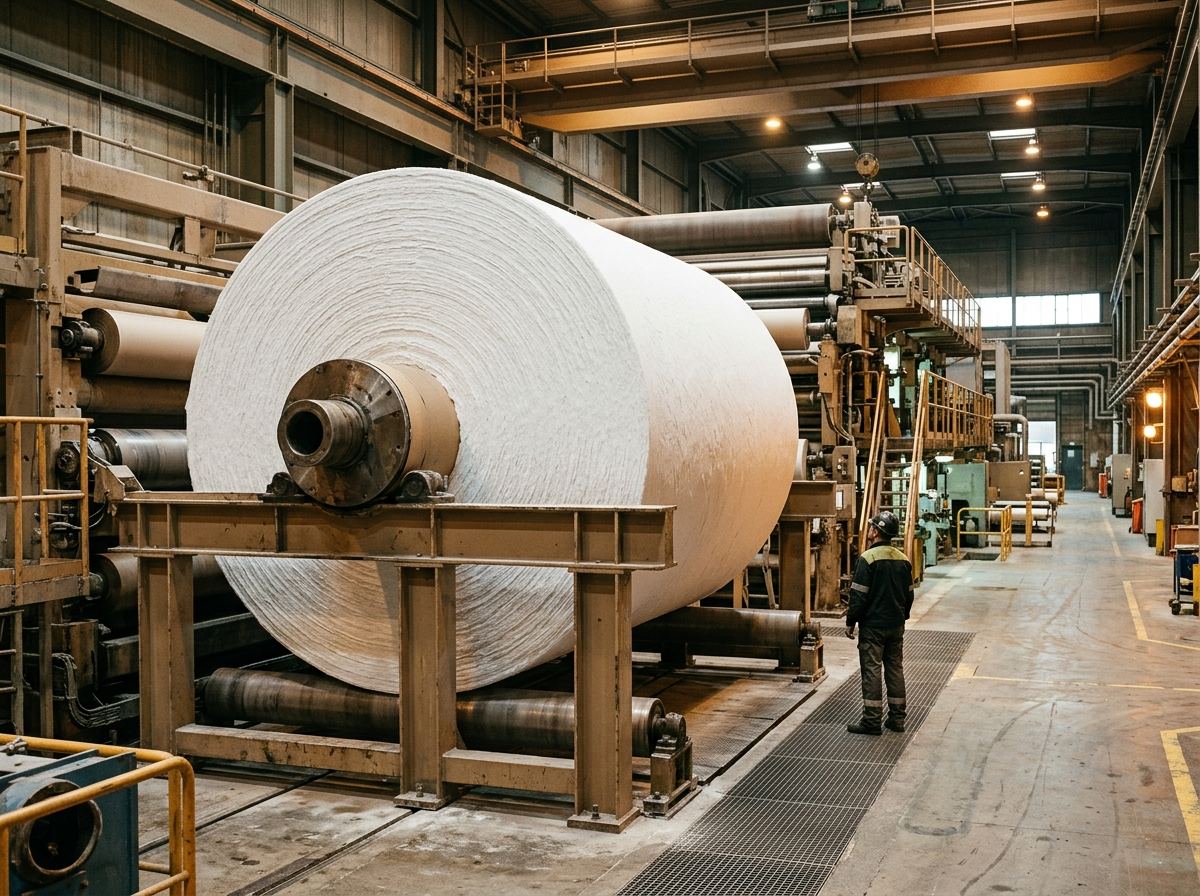
When a winder stops because a core collapsed mid-run, the cost isn’t just the lost product — it’s downtime, rewind labor, and a conversation nobody wants to have with the shift supervisor. Choosing the right paper cores for paper mills is a mechanical decision with real production consequences, and it starts with understanding exactly what you’re winding, at what tension, and what the core needs to survive it.
Why Paper Mill and Tissue Cores Face Unique Demands
Paper winding cores live in one of the most demanding environments of any converting application. Parent rolls in tissue production can be enormous — heavy, wound at sustained tension, and handled repeatedly as they move from the winder to the rewinder to the converting line. The core has to transfer torque from the winding chuck without distortion, support the full weight of the wound roll during storage and transport, and unwind cleanly without bursting, splitting, or telescoping.
Tissue roll cores face an additional constraint: they’re often small-diameter and short, handled in high volumes, and sometimes exposed to moisture or humidity in the converting environment. A core that softens or loses structural integrity under ambient moisture can cause jams, poor unwind tension, or visible product defects.
The specification conversation should start with crush strength — the core’s resistance to radial collapse under the load of a wound roll. Understanding how to spec crush requirements before you order is the single most effective way to prevent core failures on the winder.
What to Specify When Ordering Paper Winding Cores
Procurement managers ordering paper mill cores for the first time sometimes focus almost entirely on inside diameter and length. Those are necessary, but they’re not sufficient. Here’s what a complete specification looks like:
- Inside diameter: NH Paper Tube manufactures cores from 1″ to 8″ ID, with custom mandrels available for sizes outside that range.
- Wall thickness: Available from .030″ to .500″. Wall is where crush performance lives — thicker walls mean higher resistance to radial collapse, but also add weight and material cost. Spec by your actual crush requirement, not by habit.
- Length: Precision-cut from .25″ to 300″, with clean, square ends. Length tolerance matters when cores are chucked automatically — a burr or a skewed cut can cause misfeeds.
- Moisture resistance: If your converting environment runs humid or if cores will be stored near water, ask about construction options for your conditions.
- Caliper consistency: Wall variation from core to core affects chuck fit and winding tension. Consistent wall thickness across a production lot is a quality requirement, not a nice-to-have. Dimensional tolerances are confirmed per order to meet your application’s requirements — ask for them on your quote.
Sourcing Paper Mill Cores in New England
Lead time and freight cost are underappreciated factors in core procurement. A paper mill running continuous production can’t wait three weeks for a core shipment, and a truck coming from the Midwest adds cost and variability to every order.
NH Paper Tube operates out of Raymond, New Hampshire, which puts us within 1–2 day freight lanes from virtually every paper mill and tissue converter in New England — Massachusetts, Connecticut, Maine, Vermont, Rhode Island, and New Hampshire. New Hampshire has no sales tax, which reduces the net landed cost on every order for buyers in-state.
For planned production, our quick-ship and stock program keeps your most common core sizes ready to move — stock orders ship same day, with delivery across New England within 24 hours. For custom orders, turnaround runs about 5–7 business days, with emergency expedite available for a small fee when you can’t wait. Free samples are available before you commit to a production order, which matters when you’re switching suppliers or qualifying a new spec. Our minimum order is $1,000.
Our production capacity runs into the millions of cores per month, which means we can scale with a seasonal uptick in tissue production or an expansion in converting capacity without you needing to find a second source.
NH Paper Tube: Built for Paper Mill and Tissue Producers
New Hampshire Paper Tube is a spiral-wound paper tube and core manufacturer in Raymond, NH, with a team carrying 50+ years of combined industry experience. Every core we ship is made from 100% recycled paperboard, and 100% of our production waste is recycled — the finished cores are recyclable as well, which matters for mills with material sustainability programs. We manufacture to spec across the full range: 1″–8″ ID, .030″–.500″ wall, .25″–300″ length, with in-house design and logo printing if your cores need branding.
If you’re sourcing paper winding cores for a paper mill or tissue operation in New England, request a quote or call 603-693-6136. We’ll respond fast — because we know your winder won’t wait.
Related reading: “Paper Core Crush Strength: How to Spec It (and Why Cores Fail)” · “Why Paper Cores Fail on the Winder (and How to Prevent It)”.