Spiral-Wound vs. Convolute Paper Cores
When you’re sourcing paper cores for a converting or manufacturing operation, the spec sheet rarely tells you which winding method was used — and most procurement teams never think to ask. That gap matters more than it sounds. The winding method shapes how a core performs under load, how consistently it runs on high-speed equipment, and what dimensional range is even possible to manufacture. Understanding spiral wound paper cores versus convolute cores is one of those engineering fundamentals that separates a well-specified purchase from a recurring headache.
How the Two Winding Methods Actually Differ
The distinction comes down to how strips of paperboard are laid onto the mandrel during manufacturing.
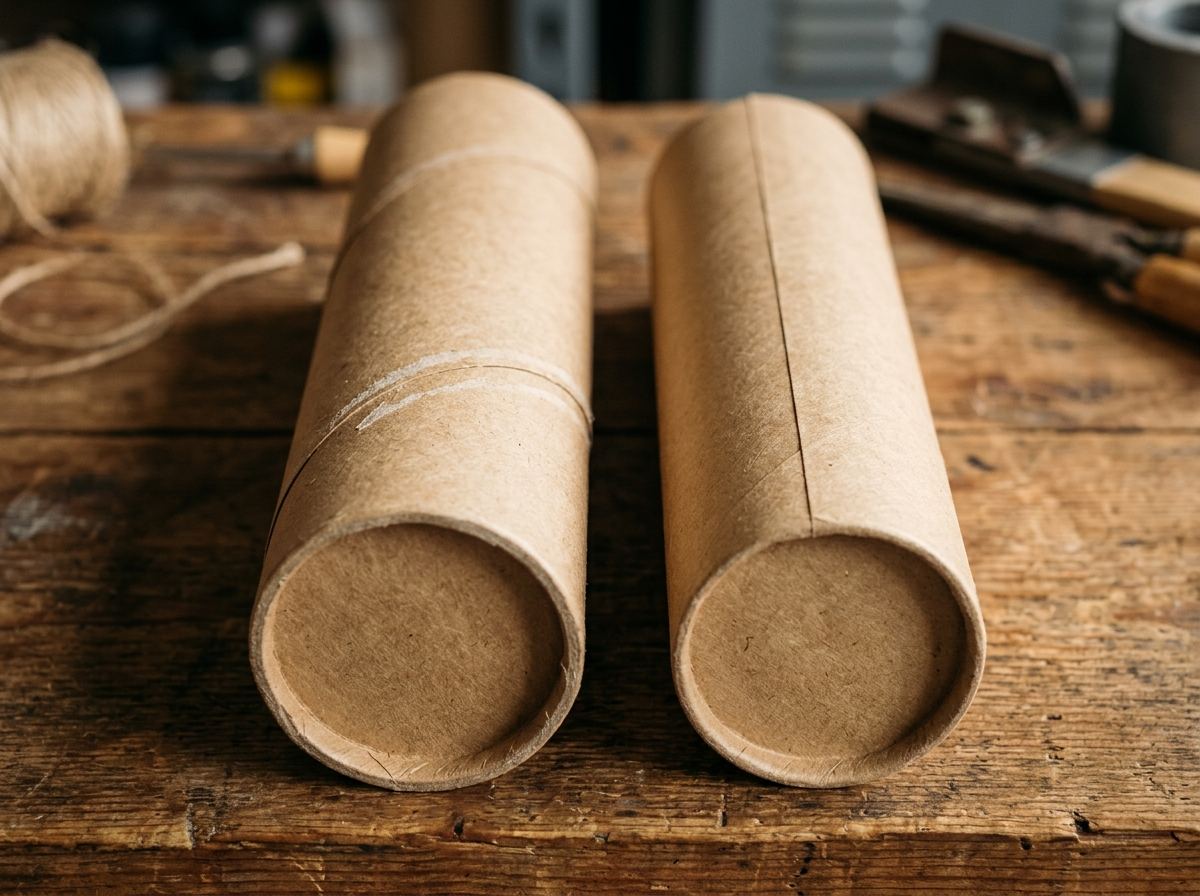
Spiral winding feeds narrow strips of paperboard onto a rotating mandrel at an angle. Each strip advances in a helix, overlapping the previous layer at offset seams — similar in concept to how a barber’s pole is striped. Multiple plies are wound simultaneously, each with its seam offset from the next, so no two seam lines align through the wall. The result is a tube with a helical seam visible on the surface and a wall structure that distributes stress across multiple interlocking layers.
Convolute winding (sometimes called parallel winding) takes a full-width sheet of paperboard and wraps it concentrically around the mandrel — think of rolling a sheet of paper into a tight scroll. The seam runs straight along the length of the tube. Each ply is a complete wrap of the sheet, so the seam lines from each ply are all parallel and stack on top of one another through the wall.
These aren’t just aesthetic differences. They produce meaningfully different mechanical and manufacturing characteristics.
Why Spiral Winding Dominates High-Volume Industrial Converting
For the vast majority of industrial applications — label stock, film, tape, tissue, yarn, coated fabrics, flexible packaging — spiral winding is the standard. Several engineering reasons drive that:
- Length flexibility. Because the tube is built incrementally as the mandrel advances, spiral-wound cores can be cut to virtually any length from a continuous production run. At NH Paper Tube, that range runs from .25″ to 300″. Convolute winding is constrained by sheet width, capping the achievable length and making very long cores impractical.
- Consistent wall structure. Offset seams through multiple plies mean no single weak line runs the full length of the core. Under lateral and radial loads — the kind a core sees on a slitter or unwind stand — this translates to more predictable performance. See our deeper breakdown of how wall construction affects performance on our paper core crush strength explained page.
- Wide dimensional range. The spiral process accommodates a broad range of inside diameters and wall thicknesses by adjusting mandrel size, strip width, ply count, and wind angle. Our custom-engineered spiral wound paper cores cover IDs from 1″ to 8″ and wall thicknesses from .030″ to .500″.
- Compatibility with automated equipment. Spiral-wound cores run reliably on high-speed converting lines. The dimensional consistency from tube to tube — critical for automatic core loading and chucking — is easier to maintain in spiral production.
- High-volume throughput. Spiral winding is well-suited to continuous, high-output manufacturing. For buyers sourcing millions of cores per month, the process scales efficiently.
When Convolute Cores Still Appear — and How to Recognize the Need
Convolute winding isn’t obsolete. It remains the right method for a narrower set of applications:
Short, large-diameter tubes — particularly mailing tubes and some specialty packaging — can be well-served by convolute winding. The geometry lends itself to thick-walled, short-length construction where sheet-width limitations aren’t a constraint.
Some composite and specialty structures use convolute construction because the straight seam and full-sheet plies suit specific layup requirements.
In practice, a buyer who needs a core longer than roughly 24–30″, or who is running on converting equipment that demands tight diameter repeatability, is almost certainly looking at a spiral-wound product. If a supplier quotes you a convolute core for a label or film application without a clear technical rationale, it’s worth asking why.
For a reference on how ID, OD, and wall thickness interact — regardless of winding method — our core ID, OD, and wall thickness chart is a useful starting point when you’re building a spec.
NHPT Makes Spiral-Wound Cores — Here’s Why That’s the Right Fit
NH Paper Tube, located in Raymond, New Hampshire, manufactures spiral-wound paper tubes and cores. We’re transparent about that: we don’t make convolute cores, and for the industrial buyers we serve — converters, mills, packaging operations, yarn and textile producers across New England — spiral winding is the correct engineering choice for nearly every application.
Our cores are built from 100% recycled OCC paperboard, and we recycle 100% of our own production waste. Custom IDs from 1″ to 8″, walls from .030″ to .500″, and lengths from .25″ to 300″ cover the full range of converting and industrial core needs. $1,000 minimum order. Stock cores ship same day with 24-hour delivery across New England; custom orders are ready in about 5–7 business days, with emergency expedite available for a small fee. We ship within 1–2 day freight lanes throughout New England — NH, MA, CT, ME, VT, and RI — and NH’s tax-free status means no sales tax on your order.
Request a quote or call 603-693-6136.
Related reading: “Paper Core Crush Strength: How to Spec It (and Why Cores Fail)” · “Core ID, OD, and Wall Thickness Explained”